A few days ago, Tavus invited me to try Griffin, a research preview they describe as a Human Interaction Model.
You open the site, pick one of four people - Ashley, Ben, Kenji or Vanessa, and start a video call. Except none of them are real.
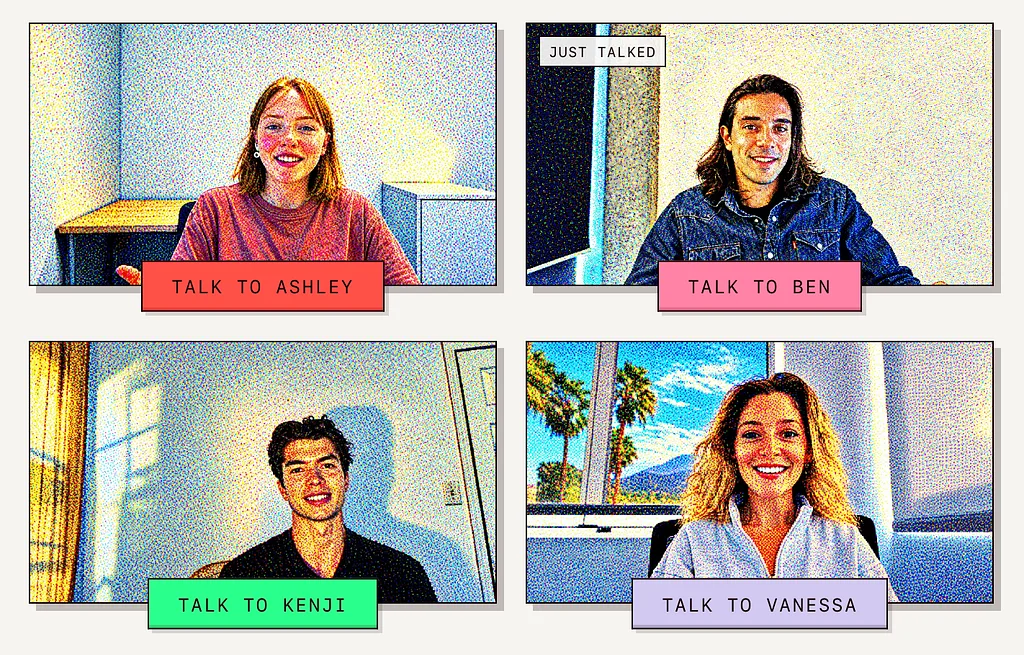
I went in expecting to mostly judge the obvious stuff: how realistic the face looks, whether the lips sync, whether it falls into uncanny valley. That ended up being the least interesting part.
It feels different when the camera is on
I talked to all four of them and deliberately tried to make the conversations messy. I interrupted them. I paused halfway through sentences. I held things up to the camera. I changed expressions.
I waited for something to break. And it did break.
There were strange facial movements, moments where the timing felt wrong, and responses that reminded me very quickly that there was a model on the other side.
But there were also short stretches where I stopped thinking about any of that. I was just talking. That was the part that surprised me. It’s so surreal when something you do visually actually changes the conversation.
If I make a face, does it react?
If I look confused, does that matter?
There’s a difference between an AI detecting something and feeling like the person you’re talking to noticed it. Griffin isn’t perfect at that distinction yet, but you can see what Tavus is aiming for.
Interrupting it
People don’t take clean turns in real conversations. We talk over each other. We say “yeah” halfway through someone’s sentence. We start speaking and then stop.
So I kept cutting Griffin off. Most of the time, it recovered perfectly. When that worked, it felt surprisingly natural. When it didn’t, the illusion disappeared immediately.
Faces are unforgiving
A chatbot can hesitate for a moment and you don’t really care. A face blinks strangely or freezes at the wrong time and your brain notices instantly. Griffin still has plenty of those moments. This is very clearly a research preview.
But I think that’s also what made it interesting to try now, rather than after everything has been polished away. Tavus says that in a small study, 26 out of 54 people who had a one-minute call with Griffin-Lite believed they had spoken with a real person.
There are obvious caveats there — small sample, short conversations, and it’s Tavus’ own study, but after using it, I can understand how that happens. Not because the face is perfect. Because sometimes enough little things line up at once. That’s what keeps going through my mind
Where I think this goes
I don’t think every AI needs a face (please do not give my code reviewer AI the ability to make eye contact lol). But there are areas where this interface starts making a lot of sense.
- Tutoring.
- Training.
- Language learning.
- Coaching.
- Interview practice.
Support where someone can simply hold the broken thing up to the camera instead of figuring out what it is called. Anything where how someone reacts contains useful information beyond the words they type. We have spent the last few years making models dramatically smarter. The interface has mostly remained a box.
Griffin isn’t there yet. But every once in a while, I forgot I was testing an AI. And honestly, that was enough to make it much more interesting than I expected.
[Read more about Griffin here](https://www.tavus.io/griffin)